


 Arizona
Latest Coverage
See all articles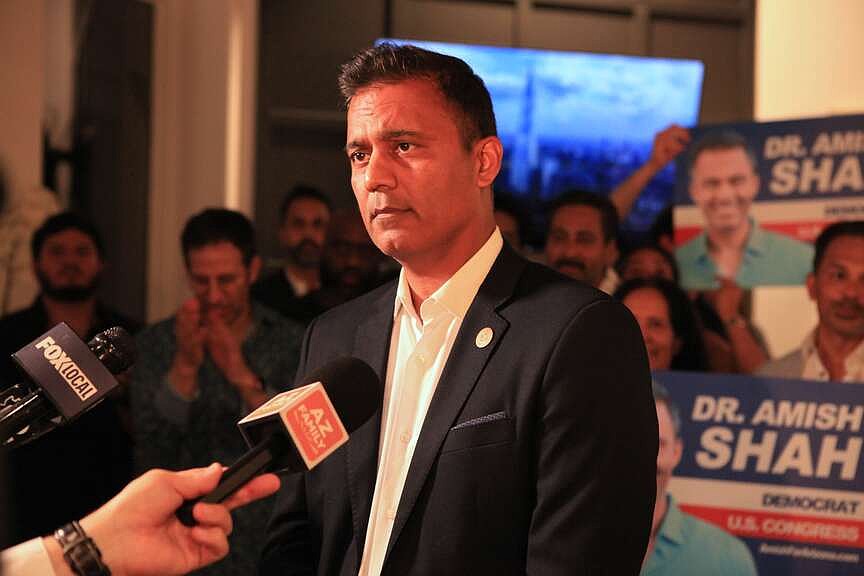
Biggs wins GOP primary in Arizona
PHOENIX -- U.S. Rep. Andy Biggs, a fierce ally of President Donald Trump and former head of the House Freedom Caucus, won the Republican nomination for Arizona governor Tuesday.
Democrats were locked in a close primary contest for a battleground U.S. House district, with emergency physician Amish Shah leading party-backed Marlene Galán-Woods for the chance to take on Jay Feely, the former Arizona Cardinals kicker who won the Republican nomination with Trump's endorsement.
A Shah victory would be another defeat for the Democratic Congressional Campaign Committee, which has occasionally struggled this year as voters seek out antiestablishment candidates. The race was too early to call early Wednesday.
Biggs overwhelmingly defeated fellow U.S. Rep. David Schweikert in the primary and will face Democratic Gov. Katie Hobbs in what could be one of the closest governor races in November.
By choosing Biggs, who supported Trump's failed attempt to block certification of his 2020 election loss, Republican voters risk nominating another conservative warrior who excites the party base but fails to win a general election by turning off independents. Although the party once dominated Arizona, Democrats now hold both U.S. Senate seats and the top three state offices.
Biggs faced travel problems leaving a Republican Governors Association meeting in Colorado, according to senior adviser Drew Sexton, and didn't reach his victory party in Scottsdale until more than three hours after he won the race. By the time he took the stage, the crowd of hundreds had dwindled to dozens and he spoke to a mostly empty room.
"Let's make this the year that we turn Arizona red again," Biggs said.
Schweikert argued during the campaign that Biggs would continue a decade of Republican backsliding. However, he struggled to raise money and did not even return to Arizona for Election Day, remaining in Washington as the House passed a government funding bill.
Biggs rejected Schweikert's claim that he'll be another Republican judged by voters to be too extreme.
"I am a conservative -- and a principled conservative -- but I work with people that don't necessarily agree with me on every issue," Biggs told a reporter after his victory speech.
Biggs, who had Trump's endorsement and support from the grassroots organization Turning Point Action, said he can unite Republicans going into the general election.
"Everyone I have talked to is really conservative around here," said Ray Roberts, a 33-year-old Republican who works as a processing engineer and knocked on doors for Biggs. "We all have mostly conservative values. I think Arizona is a red state. I think Andy will be the winner in November."
Biggs has always represented safe Republican seats and is a veteran of factional brawls within his party. Before going to Congress, he nearly lost his post as state Senate president during a confrontation with then-Gov. Jan Brewer, also a Republican, over her push to expand Medicaid.
In a statement Tuesday night, Hobbs said that "the more Arizonans learn about Biggs, the more they'll realize he's one big problem they can't afford."
The race is likely to be another close contest four years after Hobbs narrowly beat Republican firebrand Kari Lake by less than 1 percentage point. Republicans have since expanded their advantage in the state, growing GOP registration by 6% while Democratic registration fell by 4%.
Repeating her victory will require Hobbs to again win a majority of independents and some disaffected Republicans. For his part, Biggs has attacked her as a weak leader who presided over rising costs.
"We can't let the state go to somebody who's actually recklessly incompetent, and that is our current governor," he said.
Feely won the Republican primary over Joseph Chaplik, a former state legislator popular with many grassroots activists, and businessperson John Trobough. Feely had Trump's endorsement but has been dogged by criticism for living outside the district.
The Democratic Congressional Campaign Committee threw its support behind Galán-Woods, a controversial decision to get involved in a contested primary that rankled some party activists. Her late husband, Grant Woods, was the Republican attorney general in the 1990s and later became a vocal Trump critic.
Galán-Woods' chief opponent, Shah, is a former state legislator who was the nominee in 2024 but lost narrowly to Schweikert.