


 South Carolina
Latest Coverage
See all articles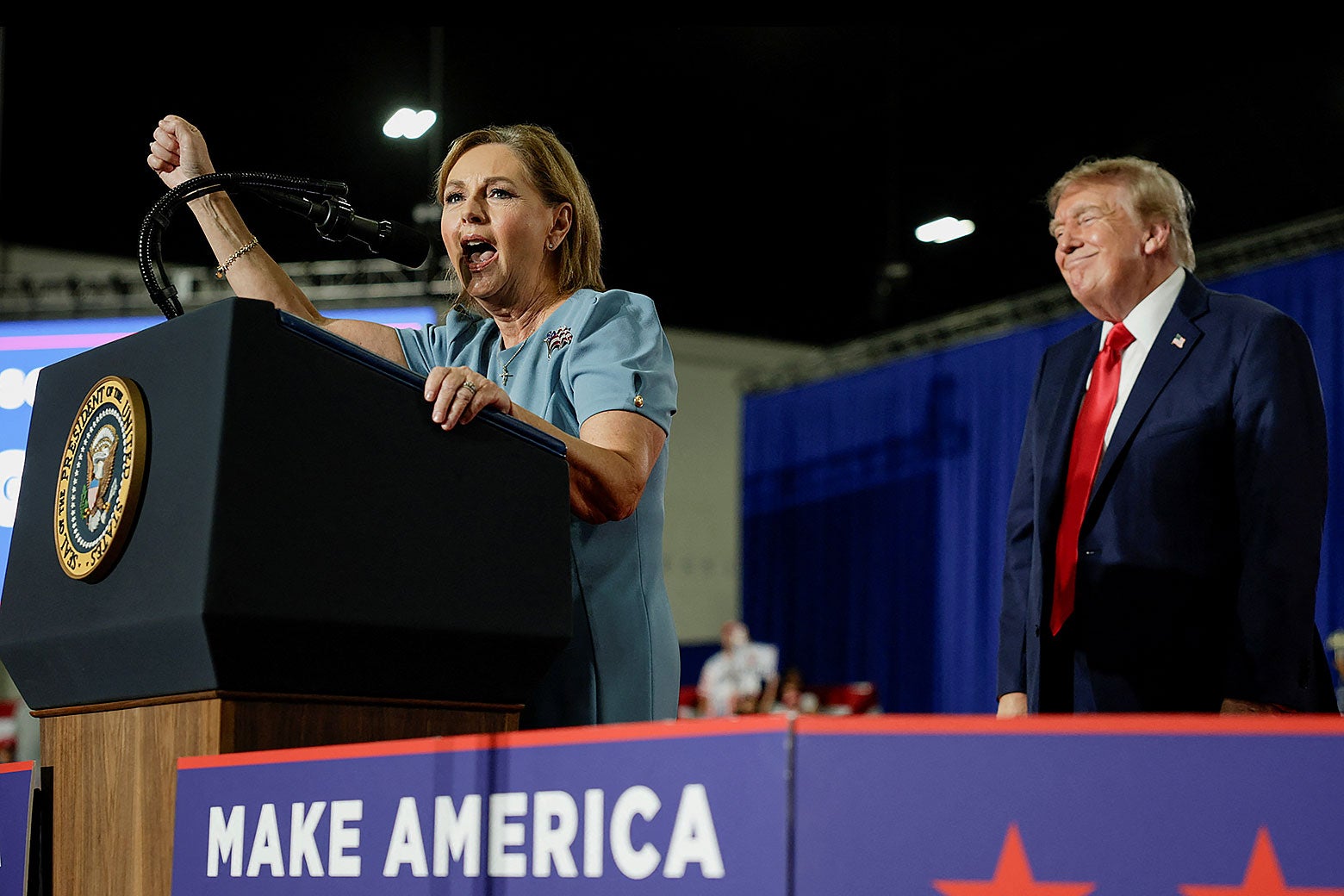
Donald Trump Can Still Win You a Certain Type of Election
On Friday, Donald Trump made a rare appearance at a political rally in Myrtle Beach, South Carolina, on behalf of Darline Graham, telling voters to pretend he was on the ballot when they voted. On Tuesday, they listened.
Graham entered politics just six weeks ago, when she was appointed to fill the Senate seat vacated by the sudden death of her brother, Lindsey Graham. At first, she was a placeholder, but then she decided to run for a full term for the seat with Trump’s backing. The race immediately became a test of whether Trump’s backing could help Graham, a political neophyte known only to voters because of her last name, win a primary election in the deep-red state.
It turns out he could. On Tuesday, Graham pulled out a victory in the Senate runoff over Rep. Ralph Norman by a margin of 52.5 percent to 47.5 percent, making her the Republican nominee for Senate and the overwhelming favorite to win a six-year term in November.
As Graham herself admitted in her election-night victory speech, directly addressing the president via the medium of cable television, “Our victory would not have been possible without you, and we are truly grateful. South Carolina is truly Trump country.”
She wasn’t merely flattering the president. Graham’s victory can be credited to the massive margins she ran up in the Pee Dee, the region of the state around Myrtle Beach where Trump campaigned for her. His rally appearance, along with the endorsement of local congressman Russell Fry, who was the third-place finisher in the first round of voting two weeks ago, transformed that region into a stronghold for Graham. Darline Graham got a higher percentage of the vote in the area than her late brother did when he won his primary in June, shortly before his death, in a far less competitive race.
Graham was also boosted by higher turnout in the runoff than in the first round of voting in the Senate special election two weeks ago. Traditionally runoffs in South Carolina have lower turnout as only the most motivated voters are willing to turn out for a second election in two weeks. This was not the case with Trump’s intervention; 33,000 more voters turned out on Tuesday than did so earlier in August. In contrast, for the regular Republican primaries in June, turnout fell off by more than 150,000 for those races where there was a runoff.
The win reinforced Donald Trump’s standing within the Republican Party at a time when it had come increasingly under question. While Trump’s status as the leader of the GOP is unquestioned, 10 candidates he had endorsed in 2026 lost their primaries, including three just last week. At a moment when Trump’s favorability is near an all-time low with the general electorate, a loss for Graham would have been a direct blow to his standing within the party, only months before midterms and on the eve of the 2028 presidential primary beginning in earnest.
Trump’s success in South Carolina’s GOP primary last night (as well as his endorsed gubernatorial candidate winning a runoff in Oklahoma) is by no means a panacea for Republicans in November. Voters are still dealing with high gas prices, a shooting war in the Strait of Hormuz, and a trade war with Canada. But it does reinforce the dilemma that they face. Trump remains overwhelmingly popular with the Republican base and can single-handedly swing primaries. But he still remains deeply unpopular with the electorate as a whole. It means swing-district Republicans have to balance on a seesaw. They can’t separate themselves too much from the unpopular incumbent lest they alienate base Republicans. But they can’t tie themselves too closely or else they may alienate swing voters.
Norman, the suburban Charlotte congressman whom Graham defeated, ran as a hard-right grassroots conservative. He warned of the dangers of socialism, berated Graham as a creature of the Washington “swamp,” and touted his disdain for Anthony Fauci and support for hydroxychloroquine as a treatment for COVID at the height of the pandemic.
However, Norman had piled up heresies against Trump. He supported his old friend Nikki Haley over Trump in the 2024 presidential primary and repeatedly dithered on supporting the president’s priorities in the House. Norman always voted the way Trump wanted eventually, but he made things difficult when it was time to vote for Mike Johnson as speaker or pass the extension of the 2017 tax cut bill.
Norman was also both helped and hurt by the fact that he had just mounted a gubernatorial campaign months before. It helped because his last campaign had just spent millions of dollars introducing him to voters statewide. It hurt because it made him seem like a perennial candidate and reinforced Graham’s attacks on the five-term congressman as a career politician.
Graham benefited not just from Trump’s endorsement but also a significant spending advantage over Norman, as well as outside groups flooding the airwaves on her behalf. She also was helped by last-minute intervention by Trump’s super PAC, MAGA Inc., which spent over $800,000 on phone calls and text messages. It was the first time this year that the group had spent in a race.
But she also faced a steep learning curve as a first time candidate. Graham’s campaign was a gaffe-filled slog culminating in a stunning debate answer where she said onstage, “National security is not my thing.”
It wasn’t just that Graham seemed new to politics but that she often seemed unfamiliar with it entirely. She struggled with generalities and answering even rote questions. After her debate gaffe, Graham tried to spin it by saying she focused on “kitchen-table issues” such as affordability. However, when the incumbent senator was asked what specific proposals she had on affordability at a press conference on Monday, she simply said, “We’ll see about that when I get there.”
Voters at a polling place in Graham’s hometown of Lexington didn’t quite describe it as a choice between the lesser of two evils, but rather “the lesser of two …” before making the universal gesture for “meh.” As Bruce Corbett, a Lexington voter who supported his hometown candidate, said of his decision to back Graham: She was “the best of the two choices we had.”
Another Lexington voter, Sharon Mason, was so unenthused about her vote that she said, “I voted for what’s-his-name,” moments after leaving the voting booth.
Graham’s massive advantage in campaign advertising was clear as many voters reiterated the negative television ads that flooded the airwaves about her opponent. “I’m tired of Norman being in there doing nothing and getting rich,” said Louise Geddings.
But other voters simply recoiled at having to vote for a candidate they viewed as entirely unqualified. “Why would I vote for Darline? She has no experience, she’s a legacy, and only running because the governor appointed her,” said Thomas Cotten.
But despite that lack of résumé, Graham triumphed on Tuesday. Then again, with a major financial advantage and running against a flawed opponent, she didn’t need a résumé. After all, she had Donald Trump. The question is what that name will do for other Republicans in November’s midterms.