


 South Carolina
Latest Coverage
See all articles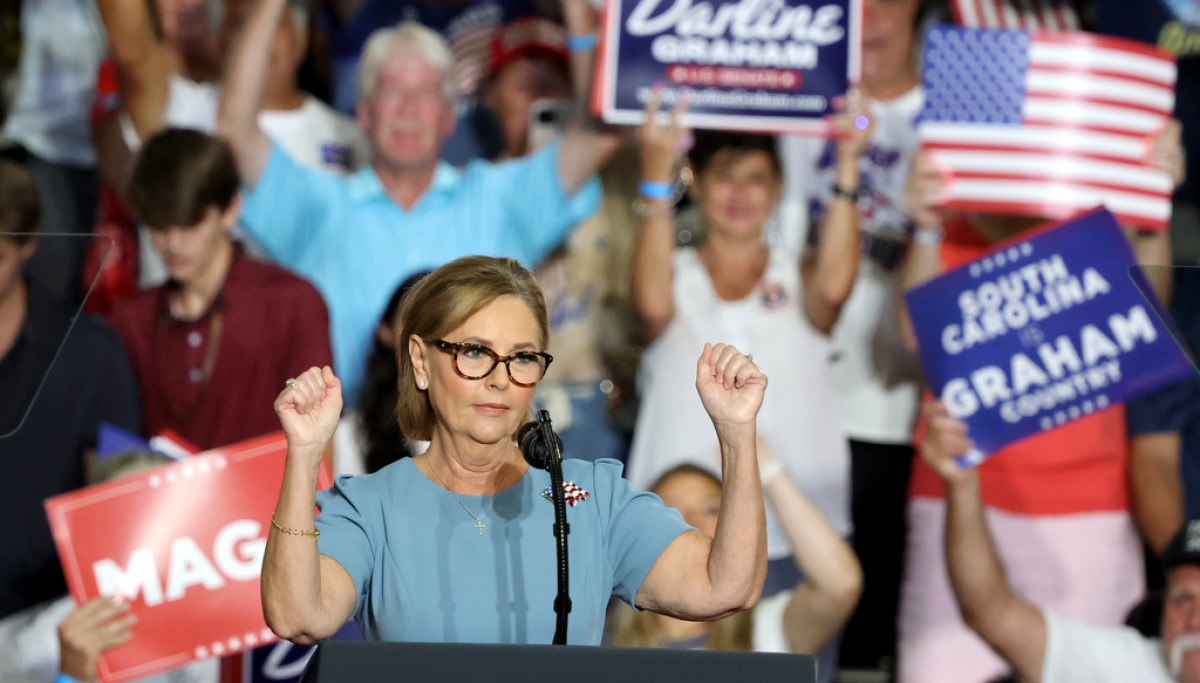
What Darline Graham's win means for the GOP
Norman was also running against a continuing positive feeling toward the Graham name among many South Carolina Republicans. Not all Republicans; Lindsey Graham always had significant GOP opposition and won the party primary in June with 57% of the vote, while his challenger, Mark Lynch, got 29%. On Tuesday, Darline Graham won with 52%. It wasn’t a landslide majority, but it reflected a solid base of support for a candidate named Graham.
One factor that likely shocked some outsiders was that Darline Graham’s embarrassing debate flub on a basic question about U.S.-Taiwan policy — the moment when Graham said, “National security is not my thing” — didn’t seem to matter at all in the election results. We know that polls consistently show voters don’t really care much about foreign policy, and this seemed to prove that.
Some attributed the fact that the Taiwan issue came up at all to the role that the national news organization Newsmax played in sponsoring and moderating the debate. “Taiwan never would have come up in a South Carolina debate,” longtime Lindsey Graham aide Kevin Bishop said. “I’ve been in a million town hall meetings and that never comes up. Lindsey would have loved it if it did, but it didn’t.” So Darline Graham did not suffer for not knowing the answer; while some outsiders thought her gaffe was a gift to Norman, in the end, it didn’t amount to much.
But some observers think there was something more fundamental going on in the Graham-Norman race, and that is that Norman was too conservative to win statewide. Given that South Carolina is a deeply conservative state, that’s worth exploring.
It mostly comes down to federal spending. One longtime conservative observer said he heard from Republican political friends that Norman is just too “Freedom Caucus conservative” for some state GOP voters. By that, he mostly meant Norman’s hard opposition to lots of federal spending for local projects — what some today call “member-directed spending” but is better known by its old name, earmarks. Norman’s policy of “zero earmarks,” the observer said, was just too much for some Republican voters.
Contrast that to the spending Lindsey Graham not only supported but actively sought for South Carolina projects. Earlier this month, this newsletter quoted Bishop noting that Lindsey Graham “helped tons of towns and communities with fire trucks, water and sewer projects, etc.,” and especially with big spending on military installations and the Port of Charleston. That is what many South Carolinians, conservative Republicans included, meant when they said that Lindsey Graham “delivered” for the state.
Now, with Lindsey Graham gone, it seems clear that a significant number of voters associated his name with continuing to “deliver” for the state. “We’ve always had senators who worked to do stuff for the state — Hollings, Thurmond, Lindsey,” Bishop said after the runoff. There was a sense among a number of Republicans that Norman would not have continued that tradition of spending. Bishop continued: “I think this is why some of the people in rural communities endorsed Darline sight unseen. If you help a town get a fire truck, that means a lot. And Lindsey did a lot of that.”
Finally, there was a regional divide on these issues that came to the surface in this campaign. It involves not just the changes inside the Republican Party but changes in the population of South Carolina.
South Carolina has one of the highest net in-migration rates in the country. People are moving there, and especially to its coastal area, in huge numbers. That changes a place. The general view among state politicos is that the new arrivals are mostly Republicans. But they are Republicans from New York, New Jersey, Pennsylvania, Ohio, and other states. So while still red, they might bring a different style of Republicanism with them.
The short version of this is that the old-style Republicans dominated in Norman’s base in the upstate area of South Carolina, while Lindsey Graham’s legacy dominated along the coast.
Norman won by 35 points in Greenville County, in the upstate. (Greenville was one of two counties, along with neighboring Spartanburg County, in which Republicans voted against Lindsey Graham in the June GOP primary.) Meanwhile, Darline Graham won by 47 points in Horry County, on the coast, which includes Myrtle Beach.
Remember that both places support President Trump in a big way. In 2024, Trump won by 22 points in Greenville County and by 38 points in Horry County. But the differences between the two counties — the differences between two styles of Republicanism — became apparent in the Senate primary.
“The more I look at the numbers, I think there are two different versions of the Republican Party in South Carolina,” Bishop said. “In the upstate, they are the old Republican Party. They are not used to ever losing; they win all the time. In that atmosphere, there is a lot of infighting — this guy’s a RINO or that guy’s a RINO.”
“But look at Horry County and the coast, where we have these new Republicans coming into South Carolina, blue state transplants,” Bishop continued. “They are so happy to be in a red state that they want to see the Republican Party get things done. The old Republicans like to fight among themselves, and the new Republicans like to fight the Democrats.”