


 California
Latest Coverage
See all articles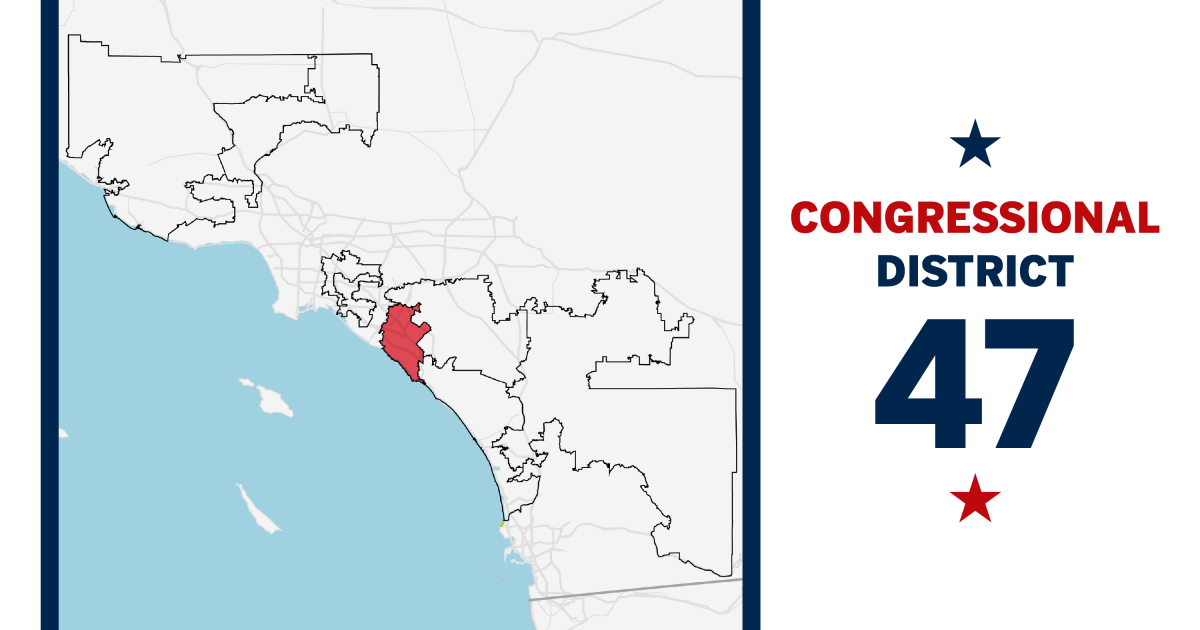
California Congressional District 47 election guide: Race for the O.C.
Dave Min: Democrat incumbent, former UC Irvine law professor
Min was elected to the U.S. House of Representatives in 2024 after a stint in the state Senate. After graduating from Harvard Law School, he worked for the Securities and Exchange Commission as an enforcement attorney.
Eric Troutman: Independent, class action defense attorney
Troutman has served as lead counsel on hundreds of national class action lawsuits brought under the Telephone Consumer Protection Act. He also founded and serves as president of Responsible Enterprises Against Consumer Harassment, a trade organization focused on stopping unwanted robocalls.
Michael Maxsenti: Republican, self-employed
Maxsenti worked on Robert F. Kennedy Jr.’s presidential campaign. He started his career in the printing industry and was president of the Max Company, where he focused on political communications for a decade, according to his LinkedIn profile.
Hunter Miranda: Democrat, attorney
Miranda started his legal career working in state and municipal law and policy and also works as a pro bono immigration lawyer. He graduated from UC Berkeley in 2020 and attended law school at American University‘s Washington College of Law, according to his LinkedIn profile.
Jenny Le Roux: Republican, business owner and director of Cal DOGE
Le Roux jumped into the political scene in California in 2021 as part of a large field of candidates running to replace Gov. Gavin Newsom in an unsuccessful recall effort. She has an MBA from Columbia Business School and owns Management Consulted, a company that works with organizations to evaluate performance and reduce inefficiencies.
Republicans Bill Brough and Christopher Gonzales, Libertarian Derrick Reid and Jesus Patino, who is listed as having no party preference, also are running.
Min, a member of the House Oversight Committee, has been a vocal opponent of the Trump administration’s sweeping immigration enforcement efforts.
In July, Min penned a letter alongside several other members of Congress to the Department of Homeland Security inspector general seeking information about alleged doxxing of federal immigration officers, which the agency used to justify allowing officers to wear masks, and disciplinary proceedings against Immigration and Customs Enforcement personnel.
“I believe in strong border security and enforcement of our immigration laws, but what ICE is doing right now goes far beyond that,” Min told The Times. “Masked and anonymous ICE agents are routinely breaking the law, assaulting civilians in the streets, violently and indiscriminately arresting people — including citizens and immigrants here with valid status — without cause, and engaging in shock-and-awe tactics like breaking windows or pointing guns at people who are not a threat.”
Min is in favor of “comprehensive immigration reform that is fair and humane” but also emphasizes border security and preventing people from entering illegally.
Maxsenti wrote on his campaign website that he supports the Trump administration’s crackdown on immigration. He is in favor of enforcing minimum sentences for drug traffickers, designating cartels as terrorist organizations and expanding task forces between the U.S. and Mexico.
“I believe legal immigration should work for America first,” he wrote. “We must focus on a merit-based system, modernize the H-1B system and guest worker programs, with vetted applicants, and streamline processing times. A merit-based system prioritizing security and economic contributions, such as Trump’s Golden Visa program, ensures safety for the American people.”
In a video posted to his campaign website in January, Troutman said he doesn’t like watching masked immigration officers carry out enforcement in cities.
“What he’s doing on immigration enforcement, it feels uneasy. It feels like an abuse of power, but the truth is he’s mostly stayed within the reins,” he said, referring to President Trump. However, Troutman said deploying the National Guard into cities was not constitutional.
He proposed a solution in which communities reverse course on sanctuary policies and work cooperatively with federal officials. In exchange, federal officials should withdraw ICE officers and work to build “facilities and processes to make sure folks are being treated fairly and humanely.”
Miranda supports a “system that is humane, fair and rooted in opportunity,” he wrote on his campaign website.
To achieve this, he proposes engaging in diplomatic partnerships with Central and South American nations to address violence and poverty, creating a streamlined pathway to citizenship for people who have been in the U.S. for more than five years with no criminal record, and reducing the backlog of applications by hiring more staff for U.S. Citizenship and Immigration Services.
He also proposes expanding guest worker programs and “shifting accountability” from workers to corporations that underpay immigrant laborers.
Le Roux told the San Diego Union-Tribune in 2021 that she supports securing the southern border with a mixture of physical barriers and an increase in Border Patrol staff. She believes in advancing immigration reform through employer sponsorship, she said.
“We need labor to power our state and our economy,” she said in 2021. “Immigrants who have led productive lives in America for many years must have a simple path to citizenship. At the same time, I will ensure that our laws treat both immigrants and natural-born residents fairly — currently, some laws favor immigrants unjustly and others punish them unjustly.”
Min’s first bill as a member of Congress in February 2025 was the Aquatic Biodiversity Preservation Act, which aimed to create a program within the National Oceanic and Atmospheric Administration to collect data on biodiversity loss and at-risk aquatic species in an effort to combat the effects of climate change.
Min also voted against efforts in Congress to rescind California’s lower emissions standards and goal to ban the sale of gas-powered cars by 2035. He told The Times that “clean energy is the energy of the future” and other countries have been investing heavily in electric vehicles, wind and solar-generated energy and battery technology that can store renewable energies.
“Despite our significant advantages in innovation and finance, the United States has fallen behind other countries in this key sector, which will be a key source of jobs and growth over the next few decades,” he said.
Maxsenti supports “energy dominance” in the United States as part of Trump’s “Drill, baby, drill” agenda that he’s put forth to expand oil, gas and coal production. Maxsenti wrote on his campaign website he is in favor of policies that “balance economic growth and energy independence with environmental responsibility.”
“California is the home to diverse ecosystems that support a wide range of wildlife, and connects us to nature. But economic realities demand that we also secure affordable energy. That’s why we need a strategic approach, focused on energy dominance, clean energy initiatives, and sound water management practices,” he wrote.
Environmental protections are a cornerstone of Miranda’s campaign. In Congress, he would prioritize funding clean energy projects, climate-resilient infrastructure and green technology to not only boost the economy but also protect the planet.
He supports offering incentives for companies to use biodegradable packaging, boosting funds for wildfire prevention, investing in seawalls and wetland restoration to protect against rising sea levels and upgrading infrastructure to protect the nation’s water supply, according to his campaign website.
“By protecting public lands, restoring ecosystems, and enforcing environmental standards, we will safeguard air, water and biodiversity for future generations,” he wrote. “We will tackle pollution, promote a circular economy and ensure that vulnerable communities are not left behind in the fight against climate change.”
In 2021, Le Roux told The Times she supports the state’s efforts to reduce greenhouse gas emissions.
“I will advance renewable energy, import less foreign fuel and stop decommissioning of hydro and nuclear power. However, many current initiatives have unintended consequences, and my plan focuses on incentives, not mandates,” she said.