


 Illinois
Latest Coverage
See all articles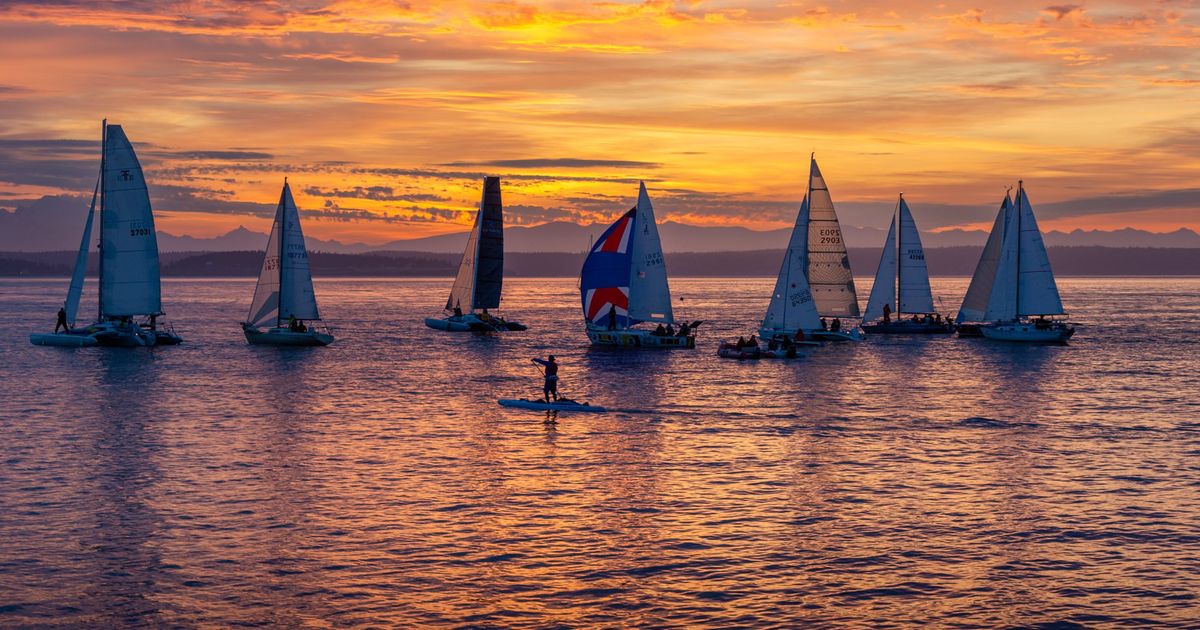
Pullman duo enters off-beat boat race to Alaska
Andy Jacobs and Eric Sorensen are a couple of normal guys from Pullman with a highly abnormal goal: Along with four friends, they plan to start – and possibly finish – a somewhat deranged boat race that stretches 750 miles from Port Townsend, Washington, to Ketchikan, Alaska. The start date is June 14.
The Race to Alaska doesn’t have a lot of rules. The big ones are: 1) No motors on the boat, period; not even for emergencies; 2) No support teams, but racers are free to forage in hardware stores, grocery stores, and burger joints in coastal towns along the way.
The prize list isn’t very long, either. First prize is a $10,000 wad of cash nailed to a log in Ketchikan. Second place is a set of steak knives.
The R2AK, which is its shorthand name, is about as far as you can get from the stuffy world of yacht clubs, blue blazers, and racing around brightly colored buoys. Think of it as a saltwater version of the Burning Man festival. Or the Iditarod, except you can drown.
Most entrants are aboard sailboats of one sort or another, but many are augmented with rowing oars and/or bicycle-style, pedal drive systems. Plenty of other racers are in bizarre rowboats, sea kayaks, and in 2017 there was a (highly capable) nut on a stand-up paddleboard who actually finished the race. All 750 miles of it.
“The organizers don’t challenge you to bring your big, million-dollar boat,” said Tara Watkins, who will be joining Jacobs and Sorensen aboard their modest sailboat, Grey Dawn. “They encourage you to bring your funky, hand-made little boat.
“The emphasis is on small, fast, and weird.”
Without question, the R2AK draws a special kind of maniac, er, mariner.
A self-reliant breed
“As soon as I heard it was a human-powered adventure race, I was all in,” said Jacobs, 43. “Being scrappy and able to invent stuff on the fly is a big part of this race.”
The Race to Alaska demands many skills of its entrants, not the least of which is being a resourceful repairman when things go bad, which they often do. A good head for logistics is useful for packing everything required for an extended voyage. Being an experienced mariner also helps.
Jacobs is one of two captains for Team Slowpoke, along with Portland, Oregon, woodworking wizard John Fisher. The two men co-own the Grey Dawn, which they found on Facebook for $5,800. Like Jacobs, Fisher has a lot of traditional racing experience – but he’s hungry for something different.
“I’ve done the racing around buoy stuff,” said Fisher, 32, “but adventure races are more my jam.”
The two men met five years ago while prepping for a different adventure race called the Washington 360. As the name suggests, it’s a 360-mile race up, down and around Puget Sound, and Jacobs distinguished himself as the last-place finisher. He could easily have quit and been rewarded with a hot shower and a nice dinner, but he stuck with it, day after day, until he crossed the finish line.
“Do not discount the last-place finisher in a race like this,” Fisher said, “because that’s the most interesting finish of all.”
Team Slowpoke is comprised of three men and three women, none of whom are intimate with one another. They’ll be aboard a 25-foot Olson sailboat for 10 to 12 days, possibly more. Along with Watkins, the women on the team are Sam Adair and Kayla Markwardt, a pair of seafarers who staff Outward Bound sailing programs off the coast of Maine.
“We’re going to one of the wildest places,” Sorensen said, “but to get there we’re going to have one of the most intense social experiences imaginable.” It will be cramped, and it will be complicated, and there is one simple command when a moment of privacy is required: “Eyes away!”
“I just love getting too many people onto a small boat,” Fisher said, his voice dripping with mischief. “It always forms such a good team.”
A test of character
“It’s a stupid thing to do. It’s a really dumb idea. You probably shouldn’t do this race,” said Jesse Wiegel, the R2AK race boss since 2023. “This is the America’s Cup for dirtbags because there’s a humor to it, and a certain amount of irreverence.”
Wiegel works for Northwest Maritime in Port Townsend, which organizes the race. For more information, visit the Northwest Maritime website, follow its social media, or watch “The Race to Alaska” documentary on Amazon Prime.
One of the first things to know about R2AK is there’s no such thing as a “typical” entrant. “For some reason, we get a lot of airline pilots who apply,” Wiegel notes, “which I suppose makes sense because you’re living at death’s door when you’re traveling at 400 mph.”
Most teams are from Washington or British Columbia, but others hail from as far away as England, Israel, Australia, and Singapore. With more than 70 entrants in this year’s race, there are some all-women teams and peppy youth teams. There also are teams of grumpy brothers and solo competitors drawn from the ranks of oddballs and loners.
“The thing that ties them all together is they’re looking to get outside of what is conventional,” Wiegel said. “They’re looking to step out of their normal lives for a while and have a look at things from a different perspective.
“Afterwards, some of them go home, quit their job, and divorce their spouse.
“This race will change you as a person.”
The first edition of the R2AK was held in 2015, so it’s fairly new in the pantheon of grueling saltwater races. The original intent was to show off the rugged coastal beauty of the Pacific Northwest. As Wiegel tells it, the origin story goes like this: A bunch of folks were drinking beer at the Wooden Boat Festival in Port Townsend when somebody piped up and said, “What if we nail $10,000 to a tree in Alaska and say, ‘Go get it!’ ”
From those humble beginnings, an epic race was born.
North by Northwest
Though it sounds lighthearted and fun, the Race to Alaska is a deadly serious undertaking. Most of the time, help is a long way off and “rescue” rhymes with “maybe.”
“We don’t promise any sort of safety support out there,” Wiegel said. Plenty of ships have gone down in those waters, and every captain wonders, “Could I be next?”
Much of the route is in the lee of Vancouver Island and other, smaller islands, but it is a raw, unforgiving place where the forces of nature have the upper hand. The wind can howl. The water is cold. The tides are horrifyingly intense. There are killer whales. And there are floating logs, barely visible at the surface.
“Actually, a lot of teams have been taken out by floating logs in the middle of the night,” Wiegel said. The prospect of disaster is never far away, which makes the fastest-ever winning time – three days, 20 hours and 13 minutes – a jaw-dropping blend of speed, skill, risk, and reward.
Most teams take more than twice that long to reach Ketchikan because the challenges of an unsupported, 750-mile race are enormous.
“Stuff breaks all the time,” Wiegel said. “Boats can capsize. A shroud lets go and your mast comes down. A boom swings and clocks you in the head. There are a lot of huge blisters and sore (backs) from people pedaling too much.
“If you’re on that pedal drive too long, there’s a lot of repetitive injury.”
With emergency help hours, possibly days, away, the emphasis is on self-reliance.
“I’m probably the least-capable person on the boat,” said Sorensen, who, at 68, is the graybeard of Team Slowpoke. “The good thing is I’m pretty confident everyone else on the team can fix any problems we might have.”
“It challenges you to think alternatively,” added Watkins, who was a last-place finisher in the R2AK four years ago. “It challenges you to be efficient when you’re using human power.
“It’s really easy to give up, really easy to go back to the dock when things aren’t going well,” she said. Like Jacobs in the Washington 360, Watkins and her two teammates stubbornly refused to surrender in the 2022 Race to Alaska.
“A lot of people were really questioning us,” Watkins said, “so we sat down one night and decided, ‘We’re going to finish this race!’ We got strong winds after that, so we doubled down, took less rest, put in longer rowing days, and got that tiny boat to Alaska.
“Going into that race, I didn’t know what my limit was,” Watkins said, adding, “Now I know it’s a lot higher than I thought.”
Unlikely boat, unlikely crew
The race doesn’t start for another couple of weeks, but Team Slowpoke already knows it isn’t going to win. That said, there are several other Olson 25s in the fleet, so the crew of the Grey Dawn plans to perk up and push harder when a rival Olson 25 floats into view.
Though they hope to be competitive with their peers, all of the Olson 25 skippers are kibbitzing with one another to iron out their respective kinks, Fisher said. The Race to Alaska is an ordeal, but the group ethos is strong.
Fisher knows his boat will be slow in the early going when everyone is fresh and there’s a lot of deadweight aboard. But north of Vancouver Island, when crews are tired and endurance is at a premium, “we’ll be more rested than the other boats,” he said.
Rest and recovery are elusive goals, Jacobs added, because Olson 25s are racer/cruiser boats that are “pretty spartan down below (in the cabin). They’re a near-shore boat, definitely not an off-shore boat.”
Preparing the Grey Dawn has been a major focus for the past few months. The boat was recently dry-docked in Edmonds, north of Seattle, so Jacobs and Sorensen often drove over for a week or more to work on it. Tasks range from the mundane – scraping and re-painting the bottom, for example – to the uncharted realm of installing and fine-tuning a home-made pedal-drive system.
For some folks, the Race to Alaska is all about the race, Wiegel said, while for others, it’s all about preparing for the race. Either way, reality bites hard when the race is on and the stakes are high.
“In a lot of ways, the world is kinda lousy these days and there’s a lot that’s fake,” Wiegel said. “This isn’t fake.
“This is as real as it gets, because when you’re in this race, you’re way outside the experience of the normal human world.”
The Great North
When things are going well, R2AK competitors are enfolded in nature’s deep embrace. The scale is enormous, with ranks of snow-capped mountains marching down to the sea, vast sweeps of dark, green forests and a mysterious, craggy shoreline that never seems to end. Now and then, gaps open up to reveal cozy bays of indescribable beauty or mighty fjords that wind deep into the interior of British Columbia.
Birds wheel and caw overhead, and energetic dolphins occasionally play at the bows. Other than the wind and the slap of waves against the hull, it’s pretty lonely out there. In sunlight and shadow, and in starlight and storm, the waters of the Pacific Northwest are endlessly alluring.
“Being in the Inside Passage is a big part of the magic of this race,” Wiegel said, “because it’s such an incredible stretch of water.
“It’s ever changing, with a vast spectrum of moods and attitudes. At one minute, it’s 45 knots blowing right in your teeth, at another moment it’s perfect sailing weather.”
Simply being there is a huge step out of the comfort zone for most folks because Mother Nature is indifferent to their survival or demise. Most of the race is along the coast of British Columbia, which is a raw, elemental place where scattered little towns eventually give way to no towns at all.
With no engine, there is no easy retreat and racers are alone with their fears. Howling winds can tear through the rigging, provoking moments of doubt. Short, steep waves can smash into the hull like it is Vulcan’s anvil. With the finish line hundreds of miles away, there is plenty of time to ponder the consequences of failure.
Those who finish the Race to Alaska share a common bond with Sir Ernest Shackleton, who knew a thing or two about lonely boat voyages in the high latitudes.
Following his epic hardships in Antarctica and the Southern Ocean more than a century ago, Shackleton wrote: “In memories we were rich. We had pierced the veneer of outside things.
“We had ‘suffered, starved and triumphed, groveled down yet grasped at glory, grown bigger in the bigness of the whole.’ We had seen God in His splendors, heard the text that Nature renders. We had reached the naked soul of man.”