


 New York
Latest Coverage
See all articles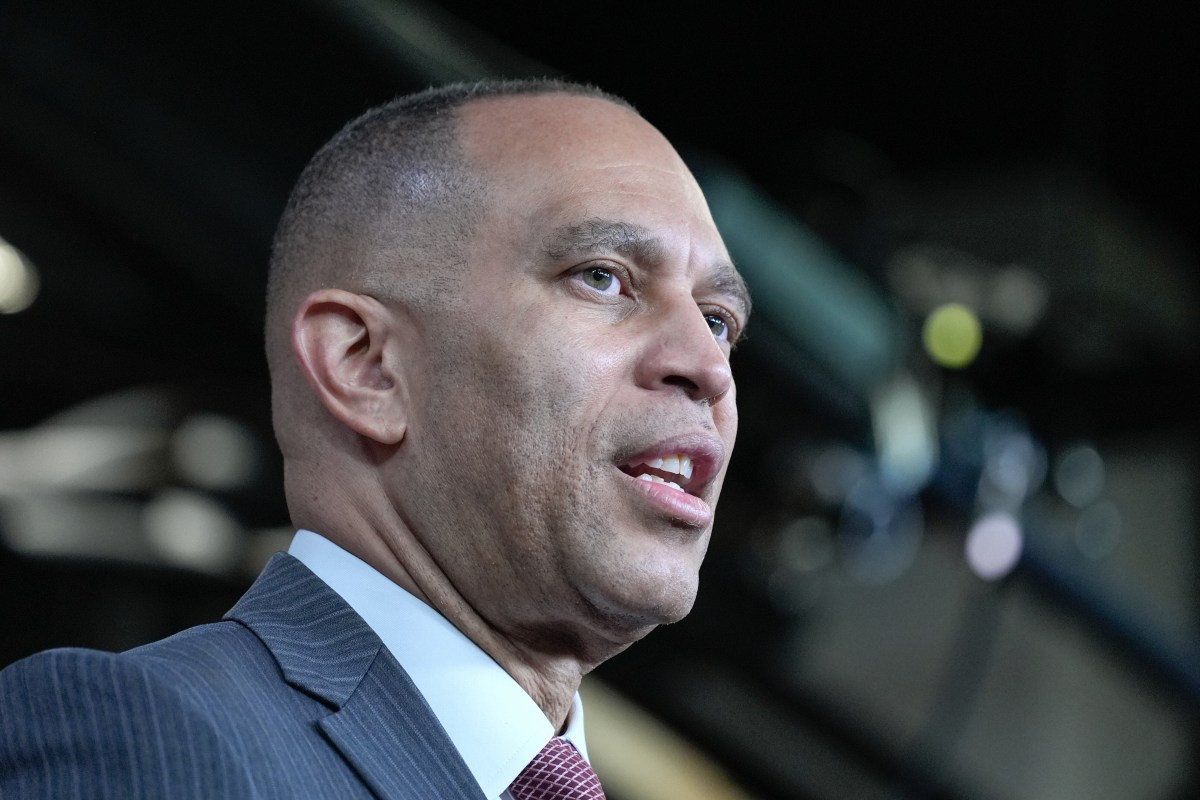
Democrats Fight Back With New York Redistricting Plan-Can It Make 2026?
New York Democrat Hakeem Jeffries has said he would not allow a "MAGA majority to be built on rigged maps" as he revealed plans to redraw maps in his home state in the latest battle in nationwide redistricting wars.
Jeffries, the House Minority leader, said in a statement that he had asked his New York Democratic colleague Joe Morelle to travel to Albany, New York, on Tuesday to meet with state leaders to discuss ways in which New York's congressional districts could be redrawn.
His request came amid a redistricting war between Republicans and Democrats to try and gain an advantage at midterms, a process that has seen multiple states including California and Texas change its congressional maps.
Last night, Republican Florida Ron DeSantis signed a map into law in Florida to favor Republicans in the state while a Supreme Court ruling in Louisiana has spurred other states to look at their maps.
There are 26 congressional seats in New York and Democrats hold 19 while Republicans hold 7. But any changes in New York are unlikely to be in place by 2026 because they would have to clear bureaucratic hurdles.
What Does Jeffries Want?
In his statement, Jeffries said Morelle will encourage New York leaders to consider a legal and constitutional review of New York's voting right tools; a 2027 state constitutional change and protections and safeguards for voting rights.
In his statement, Jeffries said: "House Republicans have failed and the American people know it. That is why GOP extremists have concluded the only way to win in November is to rig the national congressional map, beginning with Texas. Democrats fought back. We have thwarted Donald Trump’s desperate scheme through Prop 50 in California, a referendum in Virginia, regaining a seat in Utah, pushing the extremists back in Ohio and stopping Republicans in Indiana, New Hampshire, Kansas and Nebraska.”
He continued: "Across the nation, we will sue, we will redraw and we will win. House Democrats will not allow a MAGA majority to be built on rigged maps and the dilution of Black voting strength. Ultimately, this will end poorly for Republican extremists. It’s the American people who get to decide who wins the majority in Congress, not Donald Trump.”
Morelle said he was "proud to explore every option to protect voters in 2026, 2028, and beyond."
Could New Maps Come into Effect for 2026?
In March, the Supreme Court blocked a New York state court ruling that had ordered New York's map be redrawn ahead of the 2026 midterms. The state court had ruled New York's 11th congressional district violated the state's constitution and diluted Black and Latino voters but the Supreme Court reversed this decision, siding with Republicans.
Justice Samuel Alito wrote said the state court's ruling, which would have taken some Republican-leaning neighborhoods out of the district, was akin to “unadorned racial discrimination” that violated the U.S. Constitution.
For New York to change its maps, it would need approval from the state legislature and from a majority of voters. This means it is unlikely that new maps would come into effect in time for the November 2026 midterm elections.
Who Has The Advantage Overall?
There has been a national redistricting fight in which Republicans and Democrats alike have attempted to draw new state maps to affect the results of future votes and in turn affect the balance of power in Congress.
Redistricting could have a major impact on upcoming elections, including the November 2026 midterms, which will affect the balance of power in Congress and, in turn, Trump’s ability to carry out his agenda. Republicans have a narrow majority in the House of Representatives, so every seat matters. Traditionally, the party that does not hold the White House tends to do better in midterm elections.
Last week, Florida state lawmakers passed Governor Ron DeSantis' new congressional map for the state that could boost Republicans' hold on the U.S. House. DeSantis signed the bill into law on Monday.
The redrawn map would likely create up to four additional GOP-leaning districts. DeSantis said the update reflected population shifts since the 2020 Census and anticipated a U.S. Supreme Court ruling on how race can be considered when drawing districts.
There have also been Republican redistricting efforts in other states, such as Texas, Ohio, North Carolina and Missouri. Some of these efforts have sparked legal challenges.
Meanwhile, in a 6-3 decision on Wednesday, the Supreme Court weakened four decades of voting rights law, potentially giving Republicans a powerful tool to reshape congressional maps and improve their standing in the midterms and beyond.
The ruling in Louisiana v. Callais strikes down Louisiana's congressional map and rewrites the legal test for proving racial discrimination in redistricting. It opens the door for Republican-controlled states to redraw maps in ways that were previously illegal.
The court's conservative majority found that Louisiana violated the Equal Protection Clause by creating a second majority-Black congressional district to comply with Section 2 of the Voting Rights Act. Justice Samuel Alito, writing for the majority, said the state could not justify using race in redistricting without showing that Section 2 explicitly required it.