


 Michigan
Latest Coverage
See all articles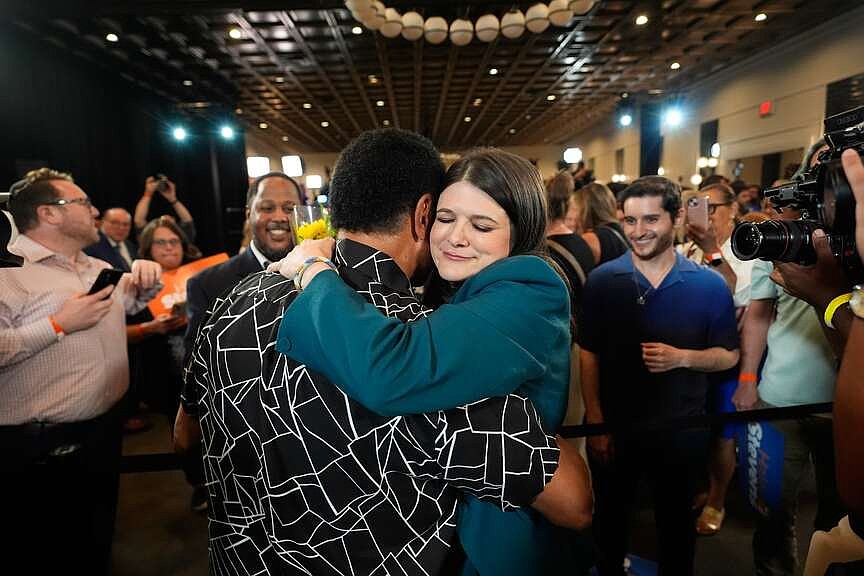
El-Sayed wins Michigan primary
DETROIT -- Abdul El-Sayed, a former public health official who harnessed Democratic frustration with the party establishment, narrowly defeated U.S. Rep. Haley Stevens in Michigan's U.S. Senate primary, setting up a crucial test for progressives in a key battleground state.
El-Sayed will face Republican Mike Rogers, a former congressman, in November in a race that will help determine control of the Senate. His first challenge will be unifying Democratic factions after a bitter primary that offered divergent visions for a party desperate for a path back to power.
El-Sayed walked off the stage at his Tuesday night election party without declaring victory, and the race was not called until early Wednesday, after nearly all ballots statewide had been counted. At the time The Associated Press declared him the winner, El-Sayed led Stevens by 14,893 votes -- just under 1 percentage point -- out of more than 1.5 million ballots counted, the most in recent state history.
El-Sayed, 41, has never held elected office and entered the race seven years after losing Michigan's Democratic gubernatorial primary by more than 20 percentage points.
This time, he overcame more than $60 million in outside spending and an opponent backed by many of Michigan's top Democrats, including outgoing Sen. Gary Peters and Senate Democratic Leader Charles Schumer.
"In the words of Muhammad Ali, we shook up the world," El-Sayed said early Wednesday, standing before The Spirit of Detroit, a landmark bronze statue in the city's downtown.
El-Sayed was joined Wednesday by state Sen. Mallory McMorrow, a former opponent in the Senate primary, and Curtis Hertel, chair of the Michigan Democratic Party. It was an initial step toward a unified front after a bitter primary, and it reflected El-Sayed's extraordinary political trajectory in less than a decade.
After losing the 2018 Democratic primary for governor to Gretchen Whitmer, El-Sayed retreated into the political wilderness. He started a podcast, wrote a book and became a regular presence on YouTube and television, slowly building a following while waiting for a political opening he did not know would come.
It arrived when Peters made the surprise announcement that he would not seek reelection, creating an open Senate seat in one of the country's most competitive states.
El-Sayed launched his campaign in April 2025 with a staff of four. In his victory speech Wednesday, he recalled the small rooms that defined its early months.
"Back in April, I remember talking to a room of five people," he said. "It was an opportunity for us to share a honest conversation about pain and about purpose. And I've been able to have 500 more of those discussions over the past 15 months."
El-Sayed campaigned on "Medicare for All," ending military aid to Israel and campaign finance reform. He had support from progressive leaders including Sen. Bernie Sanders, Vt., and Rep. Alexandria Ocasio-Cortez, D-N.Y., who framed the race as both a grassroots movement and a broader fight against the establishment and big-money spending.
El-Sayed now has three months to prove the movement that carried him through the primary can win a general election. Failure could be a dramatic setback for progressives, who have insisted for years that their approach could be more successful in a political era defined by President Donald Trump.
The Senate Republican campaign arm has already reserved $45 million in Michigan advertising to support Rogers, a number likely to grow as Republicans make clear they prefer their chances against El-Sayed.
The American Israel Public Affairs Committee, which spent more on Michigan's primary than any other race, said it would continue to oppose El-Sayed and "his radical anti-Israel agenda" in November.