


 Georgia
Latest Coverage
See all articles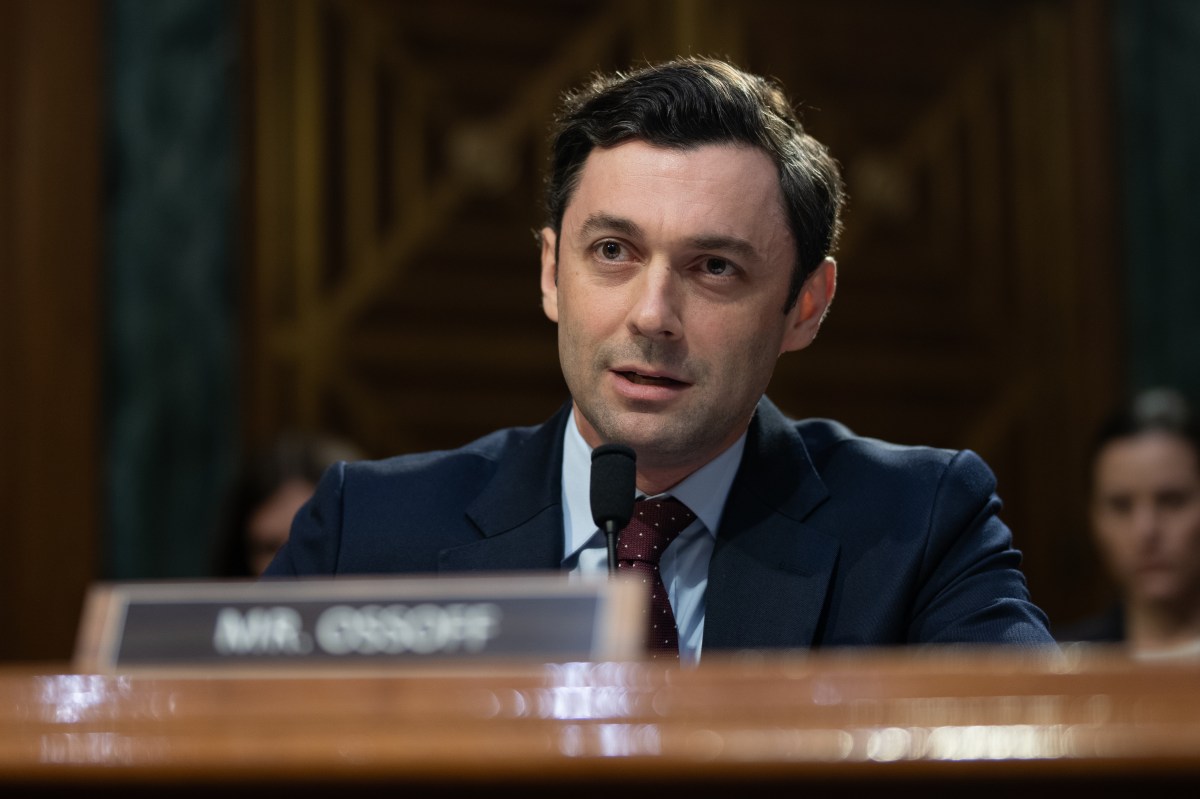
Jon Ossoff’s 2028 Momentum Is Growing
Georgia Senator Jon Ossoff was not supposed to be the story of the week in Democratic presidential politics. He is not running for president, and he says so often. But a primetime address by President Donald Trump, and prediction markets which have doubled his odds over the past month, have thrust him into the center of the 2028 conversation, even as his own reelection race remains unresolved.
The attention comes at an awkward moment for Ossoff, 39, who is locked in one of the country's most competitive Senate races against Georgia Representative Mike Collins. But strategists say the qualities that make him a top Republican target this fall—his discipline, willingness to confront Trump and ability to turn attacks back on the president—are also fueling speculation about 2028.
During Thursday night's address, Trump revisited his claims about the 2020 election in Georgia and questioned the legitimacy of the 2021 runoff victories by Ossoff and fellow Senator Raphael Warnock. Before the speech, Ossoff had warned reporters that any such move would amount to Trump calling Georgia voters illegitimate, not just the senators themselves.
Read More on Politics
Before Trump's speech, Ossoff dismissed him as the "world's most famous sore loser," accusing the president of dwelling on a six-year-old grievance while Americans grapple with rising living costs and conflict in the Middle East. Strategists say the exchange reflected a pattern that has defined Ossoff's rise. Rather than playing defense, he has repeatedly turned Trump's attacks into political opportunities.
Trump has increasingly focused on Ossoff as the senator's national profile has grown, including by giving him a crude nickname on Truth Social last month. Democratic pollster Adam Carlson summed up the moment on his X account with a mock excerpt from "Former President Ossoff's memoir in 2060," joking that the future president's political rise began with Trump's Thursday address.
Why Democrats See Ossoff as a 2028 Contender
Democratic strategists say Ossoff's campaign offers a blueprint not just for Georgia, but for the party nationally.
"Ossoff is running a masterful campaign that is a real model for candidates across the country," said Doug Gordon, a Democratic strategist and executive director of Upshift Strategies. "In one of the toughest battleground races of the cycle, he is not shying away from the fight but leaning into it."
"I think that people are getting excited about him because he does not back down from Donald Trump," Maria Cardona, a Democratic strategist and CNN commentator, told Newsweek.
Cardona pointed to Ossoff's response after Trump previously questioned his and Warnock's legitimacy as a defining moment. She said Ossoff "completely turned it around," arguing that when Trump calls Georgia's senators illegitimate, "he is essentially saying that the voters of Georgia are illegitimate," a framing she called smart politics that other Democrats have since adopted.
She also pointed to his age as an asset at a moment when the party's most senior figures, from Chuck Schumer to Bernie Sanders, face questions about generational change. She described Ossoff as "somebody who is seen as authentic, as really being able to connect with the voters," including across the full breadth of the Democratic coalition.
The Numbers Are Moving
Prediction markets have reflected Ossoff's growing profile. In early June, Kalshi and Polymarket both gave him single-digit odds of winning the 2028 Democratic nomination. By early July, Kalshi had him tied with New York Representative Alexandria Ocasio-Cortez at about 14 percent, behind only California Governor Gavin Newsom.
Polymarket showed a similar trend. Ossoff's odds more than doubled over the same period to 14 percent as Newsom's slipped. More recent market snapshots again put Newsom in front, with Ossoff, Ocasio-Cortez and former Vice President Kamala Harris grouped behind him in the high single digits or low teens, depending on the platform.
The buzz is backed by political strength. Ossoff has raised more than $57 million for his reelection campaign, with more than half coming from small donors. Prediction markets also continue to favor him to hold his Senate seat in November. He was the first millennial elected to the Senate, and his February speech branding the Trump administration "the Epstein class" has become a rallying point for Democrats calling for sharper, more populist messaging.
Ossoff has not budged publicly. He told MSNBC's Jen Psaki earlier this year that he has "zero interest" in a 2028 run and has repeatedly said his full focus is on winning reelection.
Could Jon Ossoff Become the First Jewish President?
Ossoff's Jewish identity has become part of the 2028 conversation in ways it had not before. If elected president, he would become the first Jewish person to hold the office.
He would not, however, be the first Jewish candidate on a major-party national ticket. Barry Goldwater, the 1964 Republican nominee, had a Jewish father but identified as Episcopalian. Joe Lieberman became the first Jewish candidate on a major-party national ticket when Al Gore chose him as his running mate in 2000. No Jewish candidate has ever led a major-party presidential ticket, making an Ossoff nomination a historic first.
The discussion is further complicated by Ossoff's record on Israel. He has described himself as a "pro-Israel Jewish American" while repeatedly criticizing Prime Minister Benjamin Netanyahu's government. He has voted to block some weapons sales to Israel and accused Netanyahu of being beholden to hard-line ministers Bezalel Smotrich and Itamar Ben Gvir.
That stance has cost him support from AIPAC, whose affiliated super PAC is backing Collins, while earning praise from progressive voices, including streamer Hasan Piker, who recently called Ossoff his "dark horse pick" for 2028.
Radio host Eric Messersmith argued on CNN that Ossoff could be the Democrat best positioned to bridge the party's divide over Israel because his criticism of Netanyahu gives him credibility with progressives. The segment also drew backlash after anchor Elex Michaelson suggested Ossoff "may not read as Jewish" as Pennsylvania Governor Josh Shapiro, a comment widely condemned across the political spectrum.
Reelection Comes First
None of the speculation changes Ossoff's immediate challenge. He first must defeat Collins this November in a state Trump carried in 2024. Prediction markets currently favor him, but only narrowly. Everything else, from the prediction markets to the historic implications of a potential candidacy and comparisons to a young Barack Obama, depends on that outcome.
A Fox News poll released July 1 gives the clearest picture yet of how that race stands. It found Ossoff leading Collins 56 percent to 43 percent among Georgia registered voters, a far more comfortable margin than his one-point win over David Perdue in the 2021 runoff.
Ossoff posted a 58 percent favorability rating, well above the 44 percent for Collins and the 42 percent for Trump in the state. He led among independents, moderates, voters under 30 and women under 45, and the survey found nearly a quarter of non-MAGA Republicans said they would back him, compared with just 4 percent of MAGA supporters.
Those numbers help explain why Republicans have made Georgia one of their top Senate targets. Along with Michigan, it is one of just two Democratic-held seats in a state Trump carried in 2024. Republicans currently hold a 53-47 Senate majority, while Democrats need to gain four seats to reclaim control of the chamber. Forecasters like the Cook Political Report and Sabato’s Crystal Ball view the race as Lean Democrat.
For now, Ossoff's message has not changed. He says he is focused on winning reelection, not running for president. Whether that remains true after November is the question increasingly consuming Democratic strategists, prediction markets and, after Thursday night's speech, the president himself.