


 Alabama
Latest Coverage
See all articles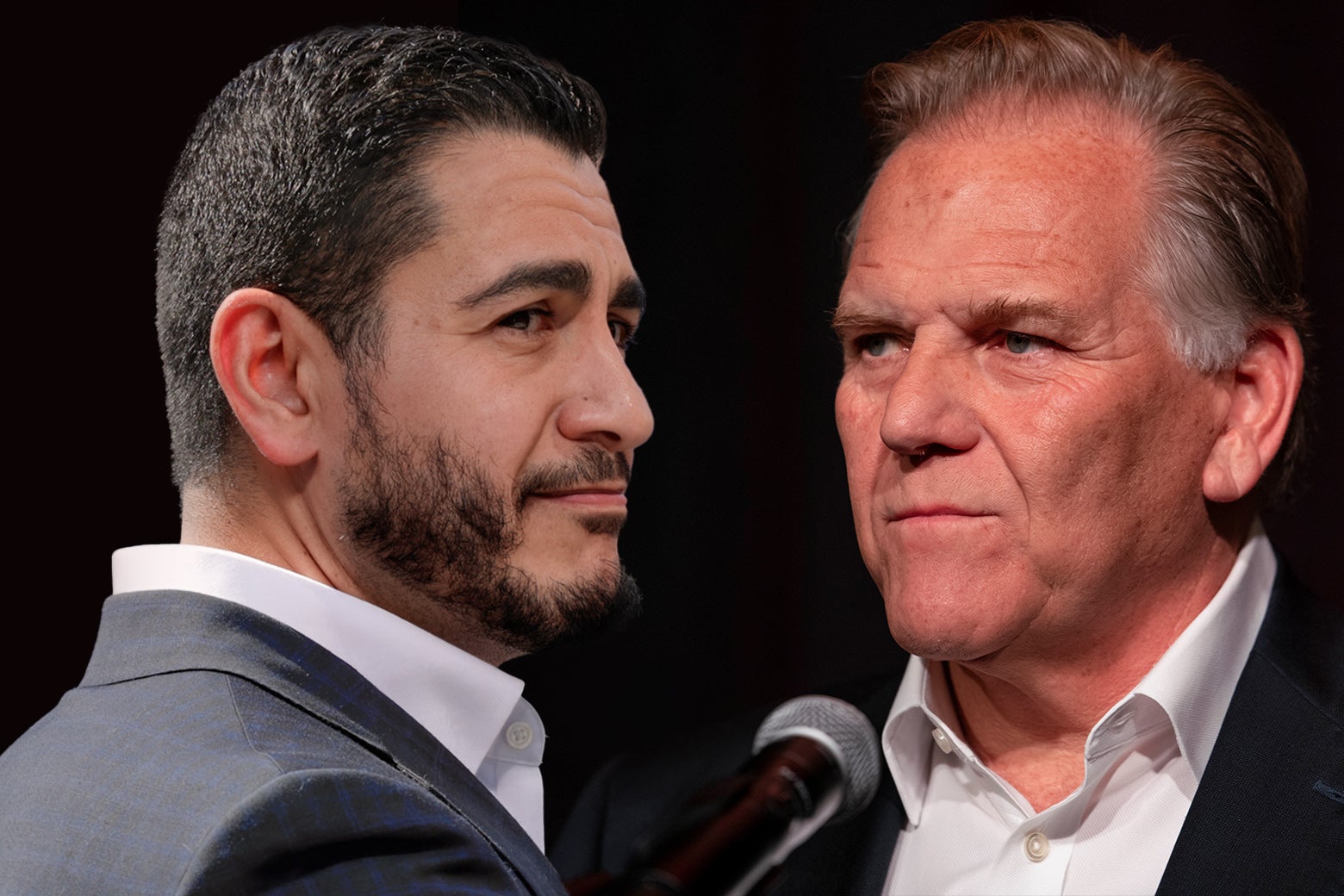
Meet the Onetime Trump Critic Running Against Abdul El-Sayed
One imagines Mike Rogers has enjoyed a lovely Michigan summer. The GOP Senate candidate was uncontested in his primary for his second straight run, after only narrowly losing to Sen. Elissa Slotkin in 2024. Rogers watched from a distance as Democratic primary candidates Abdul El-Sayed and Haley Stevens took hacksaws to each other under a national spotlight. The Republican has been little more than a hazy object on the horizon for Democrats, a reward, for better or worse, for having survived the hell on earth of the primary.
So who is Mike Rogers?
First and foremost, he is not the chairman of the House Armed Services Committee—that is Alabama Rep. Mike Rogers. Nor is he former National Security Agency Director Mike Rogers. It’s simply a popular name among bigwigs in the military-intelligence community.
Michigan Mike Rogers is a bit of a throwback to the pre-Trump GOP: a buttoned-up, country-club Republican from the George W. Bush era. A former FBI special agent, Rogers was elected to the House of Representatives in 2000. He spent his seven terms voting for usual conservative economic policies (tax cuts, deregulation) while maintaining hawkish foreign policy views. He made his biggest mark as chairman of the House Intelligence Committee from 2011 to 2015 and was a strong supporter of post-9/11 surveillance programs. During the Edward Snowden leak in 2013, he was effectively the public face of the intelligence community defending against Snowden’s revelations.
He was, in short, the sort of member that House Republican leaders liked to send as an ambassador to Meet the Press. He could show the public that the party hadn’t been overtaken looking over President Barack Obama’s birth certificate with magnifying glasses.
In 2016, two years after Rogers retired from Congress, the party was overtaken by the single person who popularized looking over Obama’s birth certificate with a magnifying glass. Rogers, who did private consulting and lobbying work but stayed in the public eye as a CNN contributor, was skeptical of Donald Trump in 2016, though offered his help to Trump after he won the election. After Trump tried to overturn the 2020 election results, Rogers became more openly critical. In a Jan. 5, 2021, op-ed, Rogers wrote that Trump sounded “more gangster than presidential” in trying to undo a “free and fair” election. Those efforts would become even more overly gangsterish the following day.
“Trump’s time has passed,” he told the Washington Post after the 2022 midterms, after Trump’s litmus tests over the 2020 election had cost the GOP opportunities across the map.
But Trump recovered within the GOP just as Rogers was eyeing a return to Congress with a 2024 Senate bid in Michigan. (In order to do this, Rogers had to relocate back to Michigan from his new home in Florida.) Suddenly, Rogers’ tune began to change as he needed to win the Senate primary. Rogers endorsed Trump for president in January 2024. You never know which mood you’re going to catch Trump in. But in Rogers’ case, Trump opted not to torture him over his history of negative comments. Trump had tarnished his brand in 2022 by endorsing numerous weak Senate candidates who lost their November races, and in 2024, he was more mercenary about picking the strongest general election candidates in the field. So Trump endorsed Rogers in turn, saying that “HE KNOWS HOW TO WIN!”
Rogers may have known how to win, but he didn’t, losing to Slotkin by a mere 19,000 votes while Trump carried Michigan in the presidential race. It was close enough that Rogers decided to give it another go in 2026, and Trump’s early endorsement of him cleared the primary field.
In the interviews Rogers has given about his strategy for the fall, he has a curious theory of the moment. He is portraying it as a “change election”—by which he means, change away from Democratic control of Michigan’s state government and its two Senate seats. This seems like an audaciously difficult argument to make. Most Michiganders are OK with their governor and two Democratic senators, and the prevailing call for “change” in the national environment this year is for a greater check on Donald Trump.
The real Rogers strategy is presenting himself as a familiar, unfrightening figure while portraying El-Sayed as dangerous—both for his left-wing populism as well as his ethnicity. Judging by early Republican messaging since El-Sayed’s win, the only question is whether Republicans will label El-Sayed a terrorist sympathizer or just do away with the “sympathizer” part. The National Republican Senatorial Committee’s press release following his primary victory referred to him by his full name, Abdulrahman Mohamed El-Sayed. The Senate Leadership Fund, the super PAC closely tied to Senate Republican leaders, said in a statement Wednesday that “El-Sayed’s radical agenda to defund and disarm the police, abolish prisons, and unleash terror and violent criminals is a direct attack on Michigan families.”
Rogers, meanwhile, said in a statement that “I spent years hunting terrorists and bringing Osama bin Laden to justice. Never in a million years did I think that I would be running against someone who believes America deserves 9/11.” El-Sayed has not said this, although one of his supporters, Twitch streamer Hasan Piker, did say it in a 2019 livestream. Expect the GOP to treat El-Sayed and Piker as the same person for the duration of the campaign.
El-Sayed, meanwhile, has promised to crush Rogers as an empty corporate suit, not dissimilar to the way he treated Stevens’ candidacy. He told reporters on primary day that he would beat Rogers by 7 points. When I interviewed El-Sayed for a feature earlier this month, I asked him what his major points of emphasis would be against him.
“The man’s never seen a corporate dollar he didn’t want to pocket,” El-Sayed said. “He voted I-don’t-know-how-many times to raise prescription drug prices. Then he helped to architect the opioid crisis.” (Rogers was an advocate for greater access to pain meds while in Congress.) “Then he moved to Florida and made $14 million. That man’s never added value in his life. So why did he make $14 million? I really want to know.
“He’s going to spend a ton of money trying to label me every which thing,” he added. “And the reality of it is: Say what you will about me, I’m not bought off. You are.”