


 California
Latest Coverage
See all articles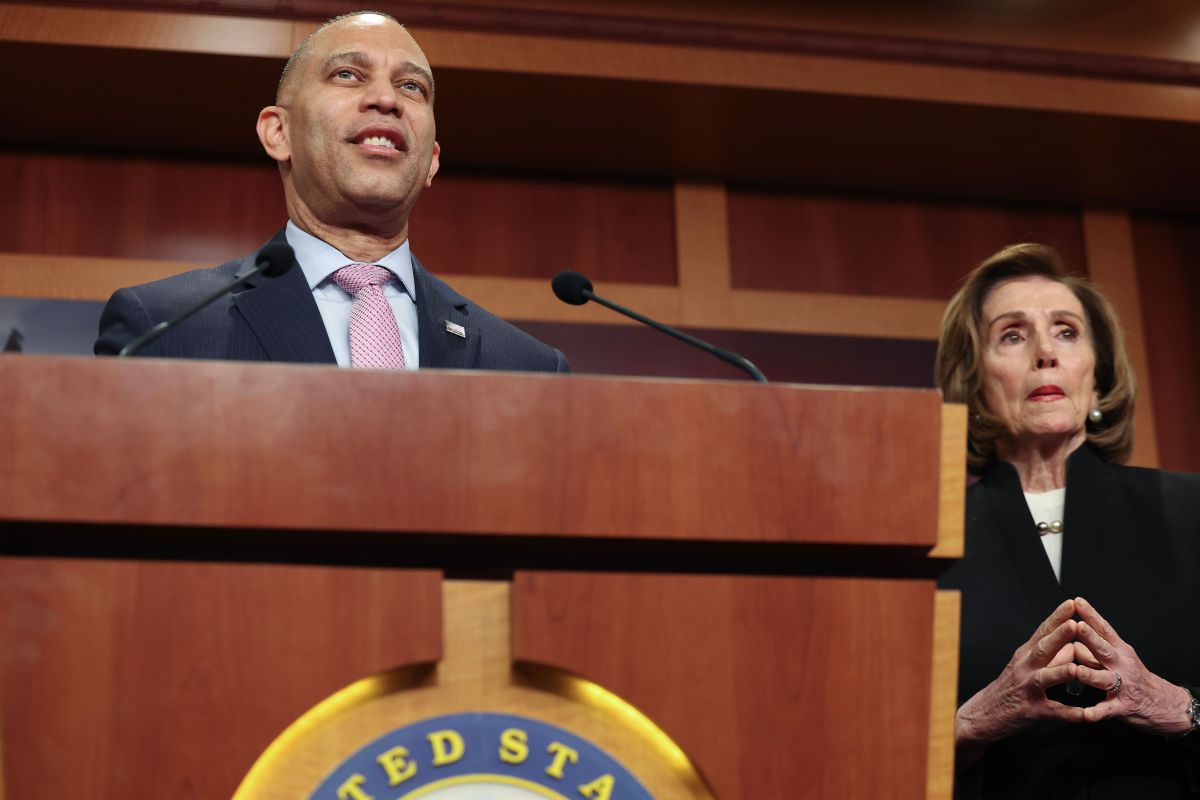
Hakeem Jeffries Struggles in Nancy Pelosi’s Long Shadow
Hakeem Jeffries has spent nearly three years leading the House Democratic Caucus from the same office where Nancy Pelosi held the job for two decades. The comparison has followed him ever since. A procedural vote this week gave Democrats a fresh reason to make it.
Maine Representative Jared Golden and Washington Representative Marie Gluesenkamp Perez, both Democrats, crossed the aisle to help Speaker Mike Johnson advance his agenda after a conservative rebellion, catching their own leadership off guard. Five conservative Republicans had planned to vote against the rule—in protest of an earlier spending fight—which would have sunk it without Democratic help. It passed 210-208.
Pelosi, who handpicked Jeffries as her successor in 2023, then drew a sharp distinction between how he has led the caucus and how she did.
Read More on Politics
“I, as speaker, never, we didn't even consider that anybody would do that,” Pelosi said. “We never had that problem, so I'm disappointed that they did that.”
Jeffries' Rocky Record as Pelosi's Handpicked Successor
Pelosi ran the House Democratic Caucus for two decades and, with only a handful of exceptions, almost nobody broke ranks on a procedural vote. It was a simple premise that helped make her one of the most effective leaders in Congress: members stay in line.
But the Golden and Gluesenkamp Perez votes on Tuesday gave new ammunition to some of the loudest critics of Jeffries’ leadership, inherited from Pelosi in 2023 with her explicit backing. They have argued that he does not have the same control over his caucus that Pelosi did.
Progressive commentator Emma Vigeland saw the incident as its own kind of failure.
“Pelosi was no leftist, but she could whip her caucus,” she wrote on social media. “She would never have been left in the dark like this. Jeffries is bad at the basics of his job, and passing the buck onto Katherine Clark is poor leadership.”
Jeffries’ tenure continued a leadership line that has passed through just three Democrats in three decades: Dick Gephardt, Pelosi and now Jeffries. Pelosi has often praised him publicly. In his 2023 TIME 100 profile, she wrote that Democrats “will make progress” under his leadership and that he was “already doing a terrific job.”
Two years into his tenure, criticism that he lacks Pelosi’s discipline and appetite for a fight has piled up. It grew louder after several Senate Democrats joined Republicans to end this year’s 43-day government shutdown without a deal on healthcare subsidies. Pelosi herself privately urged him this spring to “use your power” and take a harder line against President Donald Trump, according to CNN, as Democrats were already growing frustrated with his cautious approach.
The end of summer has been a challenging time for Jeffries. Last week, Jeffries took fire from progressives after Florida Representative Jared Moskowitz was named ranking member of the House Foreign Affairs Committee’s Subcommittee on the Middle East and North Africa last week, at a time when Democratic voters have grown increasingly critical of Israel’s conduct in Gaza.
A week earlier, Jeffries had also faced criticism after a private meeting with Jared Kushner, Trump’s son-in-law and White House envoy, became public. The two discussed areas of potential common ground, including housing, immigration and the cost of living. Two people familiar with the conversation told The New York Times that Kushner, who has no formal government post but has represented the administration in negotiations over Gaza, Ukraine and Iran, suggested Jeffries follow up with White House Chief of Staff Susie Wiles.
Veteran Democratic strategist James Carville sharply criticized Jeffries, arguing that Democrats should stop meeting with Republicans unless absolutely necessary.
“One thing that I know and you know, these are a pack of crooks, and they’re a pack of people that don’t give a s*** about the United States of America, and we don’t want to f*** with them unless we absolutely have to. No more meetings, no more bull****,” Carville said in a clip from Monday’s episode of the Politics War Room podcast.
Jeffries’ close ties to AIPAC have also made him a target of the party’s left flank, which has accused him of being too closely aligned with the pro-Israel lobbying group. New York City Councilman Chi Osse considered primarying him, while several Democratic candidates running for competitive seats this cycle have declined to say outright that they would back him for speaker if the party retakes the House.
"The era of the all-powerful speaker of the House may be over," Jim Kessler, executive vice president for policy at the center-left group Third Way, told Newsweek. "We've seen this on the Republican side since 2010 and the rise of the Tea Party. Republicans have cycled through seven House leaders over the past three decades. During that same period, Democrats have had just three: Dick Gephardt, Nancy Pelosi and Hakeem Jeffries."
Is Hakeem Jeffries Weakened Leader? What Polls Show
Polling hasn’t been kind to the Brooklyn native, either these days.
A CNN poll conducted by SSRS in July found that Jeffries' unfavorable rating had reached one of its highest points since the network began tracking him.
In that survey, conducted July 23-27, 16 percent of respondents viewed the House Democratic leader favorably, compared with 32 percent who viewed him unfavorably. The 16-point gap was the widest CNN has recorded on Jeffries since December 2022, when 17 percent viewed him favorably and 19 percent unfavorably. His unfavorable rating climbed to 27 percent in April before reaching 36 percent this spring.
A YouGov tracker measuring popularity among national Democrats tells a similar story. Jeffries ranks 22nd on the list, with a 30 percent popularity rating, well behind the party's most popular figures.
But for Kessler, while public opinion hasn’t been great lately, the bigger test, in his view, hasn’t arrived yet.
"The real challenge comes when a party is in the majority, and Jeffries will have to contain his caucus in the likely event he becomes speaker," Kessler said. "What concerns me most about the vote by Golden and Gluesenkamp Perez is that this will give the far left an excuse next Congress for their bad behavior."
Yet tensions inside the House Democratic Caucus did not start with Jeffries. For years, rank-and-file Democrats had chafed at a leadership structure that gave them little room to challenge the party’s top brass. Pelosi was simply better at keeping that frustration contained. With her gone, some of those old tensions are becoming harder to keep beneath the surface.
But not everyone sees the defections as a sign that Jeffries is losing control of his caucus. Basil Smikle, a Democratic strategist and professor of practice at Columbia University, said giving vulnerable members some freedom to break with leadership when they need to win their races can actually be a sign of strength.
“Pelosi also, to anyone that needs to run against her, should do so,” Smikle told Newsweek, referring to members who may need to distance themselves from leadership to win tough races. “Jeffries, as did Pelosi, understands that winning is important, and vulnerable Democrats this close to the election may need to make tough choices to secure a Democratic majority. I don't think it makes Jeffries look weak, but any additional defections from members in safer districts would raise the temperature of the critiques.”
Kessler agreed that Democrats should have some room to vote differently from leadership but said this was the wrong place to do it.
“I don't condone what either of these centrist Democrats did in crossing leadership and voting for the Republican rule without first informing their colleagues,” Kessler said. “That is not to say Democrats should always vote in lock step in the House or stick with leadership on every issue. Members of Congress are elected to represent their constituents, not party leadership. Nonetheless, there are places where loyalty and predictability are essential, and these arcane Rules Committee resolutions are precisely that place.”
The Democratic Party is facing broader problems with its standing among voters. A Fox News poll released this month found that 41 percent of respondents viewed the party favorably, compared with 56 percent who viewed it unfavorably. It marked the first time in a decade that Republicans were viewed more positively than Democrats in that survey.
What Golden and Gluesenkamp Perez Voted for, and Why
Golden and Gluesenkamp Perez voted with Republicans on Tuesday on a procedural rule Johnson needed to advance a package of GOP-backed bills, including a resolution denouncing "socialism in all its forms," a measure many Democrats saw as a deliberate midterm cudgel.
It also carried a bill Golden has championed to protect lobstermen in his district from fishing regulations tied to the North Atlantic right whale.
"I voted for the rule for one simple reason," Golden said. "It paved the way for a vote on my bill to protect Maine lobstermen."
His constituents, he said, "don't care about the team sports of congressional procedure," and leadership "couldn't possibly think" he would vote against his own legislation.
Gluesenkamp Perez tied her vote to the same working-waterfront politics, though she made her case on social media rather than to reporters.
"What the DC bubble doesn't get is that working waterfronts require working people," she wrote, describing a weekend fishing trip with her son. "Nature is not a terrarium, and you don't get effective environmentalism without the input of people who make their livelihoods and heritage on the water."
Neither lawmaker gave leadership a heads-up.
Newsweek reached out to Golden and Gluesenkamp Perez for comment on Wednesday.
How Jeffries and House Democratic Leadership Responded
Jeffries, Minority Whip Katherine Clark of Massachusetts and Caucus Chair Pete Aguilar of California called it, in a joint statement, a decision to "blindside the entire House Democratic Caucus and join with the Republican majority to pass a procedural rule on the brink of failing." They labeled it "a significant breach of trust" that "necessitates a serious response" and referred the matter to the Committee on Caucus Rules.
When reporters pressed Jeffries, he said: "You'll have to talk to Katherine." He later said repercussions were "under discussion." Clark had received no warning, either: "That came as a surprise," she said.
The caucus itself split.
"I effing love it," California Representative Jared Huffman said of leadership taking a hard line, adding that Democrats need to "draw a bright line here and kick some ass or this will be the new norm."
Wisconsin Representative Mark Pocan cared less about the politics and more about the process getting broken: "Everyone knows that you don't vote against a procedural vote without notifying leadership. Everyone. We're as strong as our weakest link."
Massachusetts Representative Jim McGovern wanted none of it. "No, no, no," he said when asked about punishment. "Who are we, the Republicans?"
The rank and file, speaking anonymously, used sharper language than any member would put their name to. One aide called the vote "a deeply selfish act" that "threw their frontline and other colleagues under the bus." A second was cruder, describing colleagues as simply "f***ing livid."
Some members have floated stripping Golden and Gluesenkamp Perez of their committee assignments, though nothing is decided.